)
)
rUNr: AI-Powered GIS Migration & Transformation
)
Transform. Migrate. Modernise.
rUNr, by Inovaantage, is an AI-powered data migration platform designed to accelerate the transformation of legacy GIS and network data into next-generation systems.
Built for organizations undertaking complex utility and telecommunications GIS modernization, rUNr combines artificial intelligence, automated data transformation, configurable business rules, intelligent validation, error correction, and controlled data loading to simplify the journey from legacy environments to modern Esri Utility Network and Esri Telecom Domain Network architectures.
Whether you are migrating from an existing Esri Geometric Network, legacy GIS platform, or heterogeneous data sources, rUNr helps transform a complex, highly manual migration into a repeatable, governed, scalable, and production-ready process.
Proven results
Zero Data Loss: Designed to preserve data throughout the migration process.
99% Data Auto-Loaded: Up to 99% of data can be automatically loaded following validation and transformation.
91% Errors Auto-Fixed: In proven migration projects, 91% of identified errors have been automatically corrected.
100% Connectivity Quality: Designed to preserve and validate network connectivity, spatial location, and attribution.

The Challenge
Modernizing a GIS environment is more than moving data from one database to another.
Legacy network models often contain years of accumulated business rules, inconsistent data structures, complex relationships, custom attributes, and data-quality issues. Moving this information into a next-generation network model requires organizations to understand, transform, validate, and reconcile their data while maintaining business continuity.
Traditional migration projects can involve:
-
Complex source-to-target data mapping
-
Manual interpretation of legacy data structures
-
Extensive custom scripts and ETL processes
-
Inconsistent or incomplete network connectivity
-
Geometry and topology issues
-
Invalid attributes, domains, and subtypes
-
Difficulties translating legacy models into modern Utility Network structures
-
Large volumes of manual validation and remediation
-
Multiple migration cycles
-
Lengthy project timelines
-
Significant risk associated with one-time migration processes
rUNr is designed to change this.
One Intelligent Platform. Multiple Migration Journeys.
rUNr provides a unified framework for migrating complex GIS and network data into next-generation Esri architectures.
Esri Geometric Network → Esri Utility Network
rUNr helps organizations modernize existing Esri Geometric Network implementations into the Esri Utility Network, transforming legacy network structures, relationships, attributes, connectivity, and business logic into the next-generation model.
Legacy GIS → Esri Utility Network
Migrate data from legacy GIS platforms and disparate sources into a structured Utility Network environment using configurable mappings, automated transformations, intelligent validation, and automated error correction.
Legacy Telecom GIS → Esri Telecom Domain Network
rUNr supports the transformation of telecommunications network data into the Esri Telecom Domain Network, helping organizations establish a modern, connected, and scalable network information model.
AI at the Heart of Migration
rUNr uses AI to help understand and accelerate complex migration tasks. Rather than relying solely on manually created migration rules, rUNr can assist in identifying relationships and patterns across source data, helping migration teams understand what the data represents, how it should be transformed, and where potential issues exist.
AI-Assisted Capabilities
Data Discovery
Automatically profile source datasets and identify structures, attributes, relationships, patterns, and potential anomalies.
Intelligent Mapping
Assist in identifying relationships between legacy data models and target Utility Network or Telecom Domain Network structures.
Transformation Intelligence
Apply configurable business rules and transformations to convert legacy structures into the target information model.
Connectivity & Relationship Analysis
Analyse network relationships and connectivity to support migration into modern network models.
Data Quality Intelligence
Identify missing, inconsistent, duplicate, invalid, or potentially problematic data before and after migration.
Automated Error Correction
Apply configurable rules to automatically correct eligible data-quality, geometry, connectivity, and business-rule errors before loading.
Migration Recommendations
Surface mapping gaps, transformation issues, and data exceptions for review.
Continuous Validation
Validate migrated data against defined rules and target requirements, creating an auditable migration process.
From Legacy Data to a Production-Ready Network
rUNr provides an end-to-end migration workflow.
01 — Discover: Understand your legacy data landscape through automated profiling and analysis.
02 — Analyse: Identify structures, relationships, attributes, connectivity, business rules, geometry, and data-quality challenges.
03 — Map: Create and manage source-to-target mappings using intelligent and configurable migration logic.
04 — Transform: Convert legacy structures, attributes, geometry, relationships, and network information into the target Utility Network or Telecom Domain Network model.
05 — Validate: Run automated pre- and post-migration quality checks to identify exceptions, quality issues, and migration gaps.
06 — Auto-Fix: Apply configurable business rules to automatically correct eligible errors and prepare data for loading.
07 — Remediate: Review and resolve remaining exceptions through an iterative migration and validation process.
08 — Load: Automatically load validated and transformed data into a controlled, production-ready target architecture.
09 — Report: Provide migration metrics, exception reporting, traceability, quality statistics, and audit information.
Built for Complex Network Data
rUNr is designed for the realities of enterprise GIS migration.
Data Model Transformation: Move beyond simple field-to-field ETL with intelligent transformation of complex legacy structures into modern information models.
Network Connectivity: Preserve, transform, and validate connectivity relationships that are fundamental to network operations.
Attributes & Relationships: Transform asset attributes, relationships, associations, domains, subtypes, and related information according to target requirements.
Geometry Transformation: Transform and validate spatial data as it moves between legacy and next-generation models.
Business Rules: Implement fully configurable migration rules that reflect organizational requirements and target-system constraints.
Automated Error Correction: Automatically identify and correct eligible errors before data reaches the target production environment.
Exception Management: Identify migration exceptions and provide a structured mechanism for review, remediation, and reprocessing.
Repeatable Migration: Run migration cycles repeatedly as source data and mapping rules evolve—reducing the risk associated with one-time migration processes.
Rapid Model Changes: Quickly accommodate upgrades and ad-hoc data model changes without rebuilding the entire migration process.
Comprehensive Data Quality
Data quality is built into the migration process rather than treated as a final-stage activity. rUNr provides pre- and post-migration quality checks across geometry, topology, attributes, business rules, and network connectivity.
Geometry Checks
-
Positional accuracy
-
Duplicate features
-
Duplicate vertices
-
Null geometry
-
Multipart features
-
Self-intersecting features
-
Overlapping features
Topology & Connectivity Checks
-
Dangles
-
Feature-on-feature overlap
-
Disconnected points
-
Disconnected polylines
-
Invalid connectivity
-
Junction-edge rule conflicts
-
Incompatible feature subtypes
-
Connectivity policy violations
Attribute Checks
-
Null values
-
Invalid domains
-
Invalid subtypes
-
Attribute consistency
-
Business-rule compliance
Automated Error Correction
One of rUNr's key differentiators is its ability to move beyond simply identifying errors. rUNr can apply configurable business rules to automatically correct and edit eligible data before loading. In a proven migration environment:
- 91% of identified errors were automatically fixed
- 9% required manual intervention
This significantly reduces the volume of data requiring manual remediation and helps migration teams focus their time on genuinely complex exceptions.
Proven Migration Approach
rUNr uses an iterative migration methodology designed to progressively increase data quality and confidence.
Phase Zero — Sample Dataset
A representative sample dataset is pushed through a dummy migration.
The process identifies:
-
Data-model gaps
-
Connectivity issues
-
Geometry problems
-
Attribute issues
-
Business-rule conflicts
-
Transformation requirements
-
Mapping gaps
Migration rules are then refined through iterative cycles.
Phase One — Whole Dataset
Once the migration process has been validated and refined, the approach is applied to the complete dataset. This progressive approach allows organizations to identify and resolve issues early rather than discovering them after a full migration attempt.
Typical progression: Sample Dataset → Iterative Refinement → Whole Dataset → Production-Ready Migration
The result is a more controlled, predictable, and repeatable migration process.
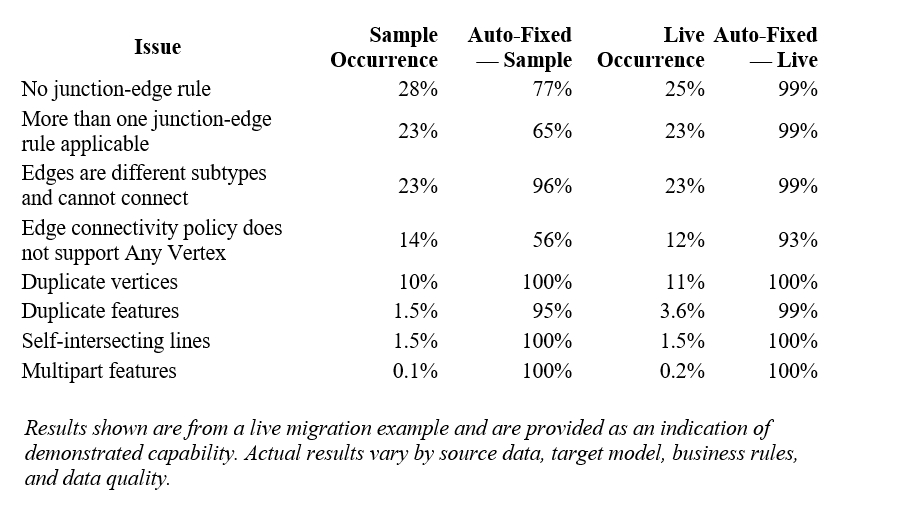
Proven Results from a Live Migration
A live project demonstrates the scale and automation capabilities of rUNr.
- 2.16 Million Total features
- 91% Transferred automatically with no issues
- 26,000 Features requiring business-rule editing
The migration process identified both data-quality and network-model issues and automatically corrected a significant proportion of them.
Example Data Quality Results
Designed for Utility & Telecom Transformation
Utilities: rUNr can support migration programs across utility domains including:
-
Electric
-
Gas
-
Water
-
Wastewater
-
District energy
-
Multi-utility environments
From legacy network models through to modern Utility Network implementations, rUNr provides the intelligence and automation required to manage large-scale migration programs.
Telecommunications: For telecommunications organizations, rUNr supports the migration and transformation of network information into the Esri Telecom Domain Network, helping establish a modern foundation for managing increasingly complex fibre, cable, wireless, and supporting infrastructure.
Reduce Migration Risk
A successful migration is not simply about moving data. It is about confidence in the data at the end of the process. rUNr helps organizations establish that confidence through:
Traceability : Understand where migrated data originated and how it was transformed.
Validation: Identify potential issues before they reach the target production environment.
Automated Correction: Automatically resolve eligible errors before loading.
Repeatability: Execute migration processes consistently across multiple environments and migration cycles.
Governance: Create a structured, controlled approach to migration rules, transformations, exceptions, and outcomes.
Visibility: Give project teams clear insight into migration progress, data quality, automated corrections, and outstanding issues.
Accelerate Your Modernisation Journey
Traditional migration projects can require significant manual effort across data analysis, mapping, transformation, testing, remediation, and validation. rUNr brings these capabilities together in a single intelligent migration platform.
Reduce: Manual migration effort and repetitive data-processing activities.
Accelerate: Data discovery, mapping, transformation, testing, correction, and migration cycles.
Improve: Data quality and confidence in the migrated network.
Standardise: Migration processes across projects, business units, regions, and network domains.
Scale: Migration workflows to support large and complex enterprise datasets.
From Migration Project to Migration Factory
rUNr is not designed only for a single migration. Its architecture enables organizations to establish a repeatable migration capability that can be reused across programs, regions, data sources, and network domains.
Build once. Refine continuously. Reuse at scale.
As migration rules and transformation logic mature, organizations can create a reusable migration framework rather than repeatedly developing bespoke scripts and processes. Whether migrating one legacy system or executing a multi-year GIS modernization programme, rUNr provides a foundation for creating a more efficient and intelligent migration operation.
Why rUNr?
AI-Powered: Use AI-assisted analysis and intelligence to accelerate complex migration tasks.
Automated: Automate transformation, validation, correction, and loading wherever possible.
Configurable: Adapt migration logic and business rules to the requirements of each organization and target architecture.
Quality-Focused: Validate geometry, topology, connectivity, attributes, and business rules throughout the migration lifecycle.
Repeatable: Create migration processes that can be executed repeatedly as data and requirements evolve.
Production-Ready: Move from legacy data to a validated target architecture with greater confidence and control.
The Next Generation of GIS Migration
Legacy GIS environments were built for a different generation of network management. Modern Esri Utility Network and Telecom Domain Network implementations provide the foundation for more connected, intelligent, and operationally aware network management.
rUNr bridges the gap.
It combines AI-assisted data understanding with configurable transformation, automated error correction, validation, and controlled migration capabilities to help organizations move from legacy network models to the next generation of GIS.
Your data is valuable. Your migration shouldn't be a barrier to modernisation. Discover what rUNr can do for your migration programme.
Copyright © 2025 Inovaantage. All rights reserved.