)
)
In Conversation with Anthony Smith: Data Centre Growth is Accelerating. Can the Grid Keep Pace?
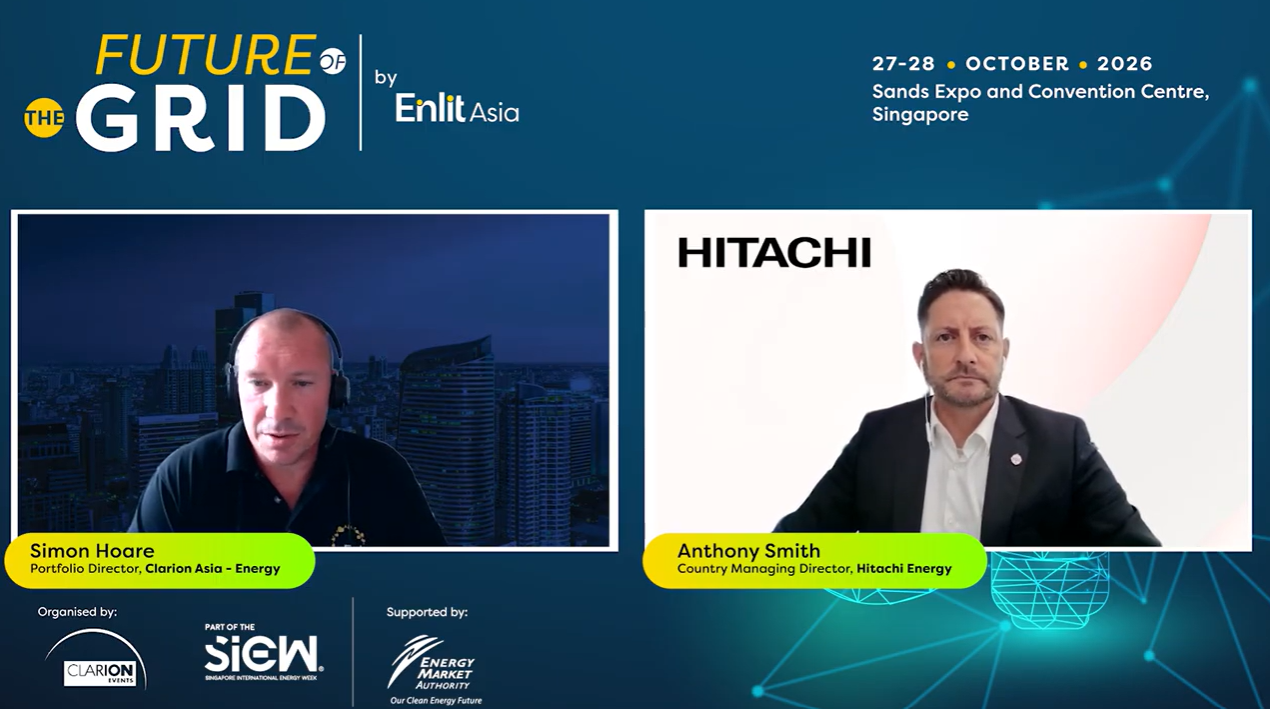
Southeast Asia’s data centre market is expanding rapidly, driven by continued digitalisation, cloud adoption and, increasingly, the extraordinary growth of AI. With this expansion comes an equally rapid increase in electricity demand, placing greater pressure on power systems already being asked to accommodate economic growth, electrification and increasing volumes of renewable energy.
Sitting at the centre of all of this is the grid. We recently spoke with Anthony Smith, Country Managing Director, Singapore at Hitachi Energy, about what accelerating data centre development means for power infrastructure across Southeast Asia, where capacity constraints are emerging, and what needs to change if grids are to keep pace with demand.
The issue is not simply whether enough electricity can be generated. Power availability, reliability and the infrastructure required to deliver it are increasingly influencing investment decisions. “For data centre developers, the key question is not any more about where to build, but when will power and utilities be available?” Anthony explained, alongside questions around reliability and whether supply aligns with sustainability commitments.
Compounding this is the speed at which the industry is developing. Projects that previously took around 24 months from planning to energisation are, in some cases, being compressed to eight to 12 months, creating a mismatch with the longer development cycles associated with substations, transformers, transmission upgrades and other critical grid infrastructure.
AI adds further complexity. The challenge is not only greater electricity demand, but increasingly concentrated and dynamic loads, creating new requirements around power quality, grid stability and operational resilience. Hitachi Energy is developing solutions around these changing requirements, including grid-to-rack solutions for 800-volt direct current architectures, intended to reduce energy waste and cooling requirements while accelerating AI deployment.
However, simply adding generation or deploying new technology will not solve the capacity crunch. Much of the answer lies in how data centres and the infrastructure supporting them are planned.
Earlier Integration, Not Simply More Infrastructure
Four barriers stand out: timing, coordination, operating models and regulation. Facility design, grid connections, renewable energy strategies, onsite generation and storage are still often planned independently, when the scale and speed of current development increasingly requires them to be considered together.
“To meet today’s scale and speed requirements, we think these elements need to be planned and considered as an integrated energy ecosystem from the very beginning,” Anthony explained.
This also raises the question of the role data centres themselves can play within the wider power system. As large electricity consumers, there is growing potential for them to become active grid partners through CPPAs, onsite generation, storage and flexibility. Yet this needs to be balanced against an operating model built around near-perfect availability, where uptime, cybersecurity and power quality will inevitably remain the priority.
Regulation adds another challenge, particularly across Southeast Asia where frameworks governing PPAs, storage, onsite generation and demand response vary significantly. Singapore was highlighted as a good example of a market introducing requirements around lower-carbon energy use and operating frameworks for data centres, while other markets across the region develop their own approaches.
Building the Grid-Ready Data Centre
Addressing these challenges ultimately requires a different relationship between data centres and the power system. Rather than simply being consumers of electricity, “data centres need to be an active and intelligent and resilient part of the wider power system”.
This starts with robust and scalable grid connections and infrastructure capable of expanding alongside rapidly changing demand, with renewable energy, onsite generation and storage integrated where they make technical and commercial sense.
Digitalisation will also play an important role. Hitachi Energy’s HMAX Energy platform, launched in March 2026, uses AI for planning, prediction and preventive maintenance across infrastructure including transformers, switchgear, substations and power quality solutions. This ability to identify potential issues before they affect operations forms part of a broader approach incorporating efficient equipment, compact infrastructure and lifecycle services.
Perhaps the clearest message from our conversation, however, is that much of the technology required already exists. The bigger challenge is deploying it quickly enough.
“There’s a lot of good technology that largely exists today around making data centres efficient and more sustainable. The real question is how quickly can we deploy that technology?”
Doing so will require earlier planning and more strategic relationships between developers, utilities, regulators, OEMs and infrastructure providers. As Anthony put it, the priority should be to “plan ahead of demand rather than reacting to it”.
For an industry where development timelines continue to shorten while power requirements increase, bringing the power ecosystem into the conversation earlier may ultimately prove as important as any individual technology.
Hear more from Anthony Smith, Country Managing Director, Singapore at Hitachi Energy, at Future of the Grid 2026, where he will join the panel The Capacity Crunch – Grid Readiness to Support Data Centre Growth and Beyond.